
How can we keep traffic flowing?
We all want to get around Yarra safely, so we can visit friends, the library, shops or services. But, too many people find that it’s difficult to drive in Yarra because congestion is becoming severe. This isn’t merely an issue of convenience, it’s an issue of social justice for people who need to drive, who should be able to get where they need to go without experiencing severe congestion or gridlock.
What Yarra can do
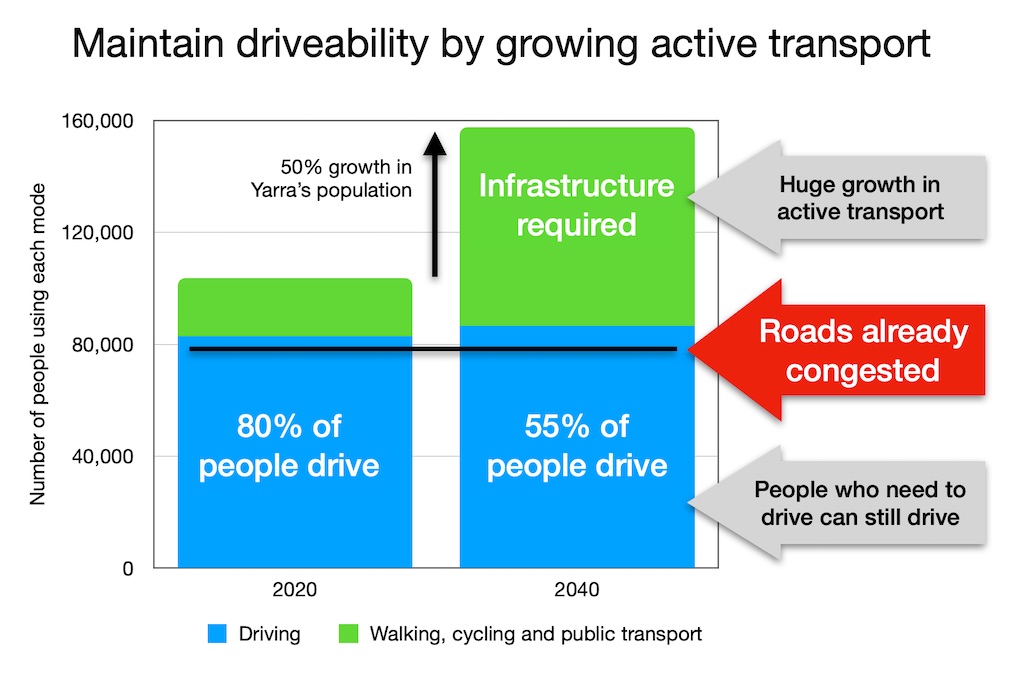
As explained in the video, the solution is to offer alternatives to driving – safe, cohesive networks for walking, cycling and public transport – so that people who are willing to ‘have a go’ with other modes are able to, thus freeing up space for those who need to drive. These improved alternatives can be introduced alongside demand responsive driving charges and demand responsive parking charges, to help ‘flatten the peak hour curve’. In addition, mandating parking maximums for new developments will help slow the growth of peak hour traffic.
How other modes can help
Other modes of transport require less space than driving. If other modes are allocated a reasonable amount of street space, they can carry more people than a vehicle lane, especially during peak hour. If enough people choose other modes, especially for short journeys (less than 5 km, which is the north-south distance of the City of Yarra), then there will be more space on the road for people who need to drive.
Support from Infrastructure Victoria
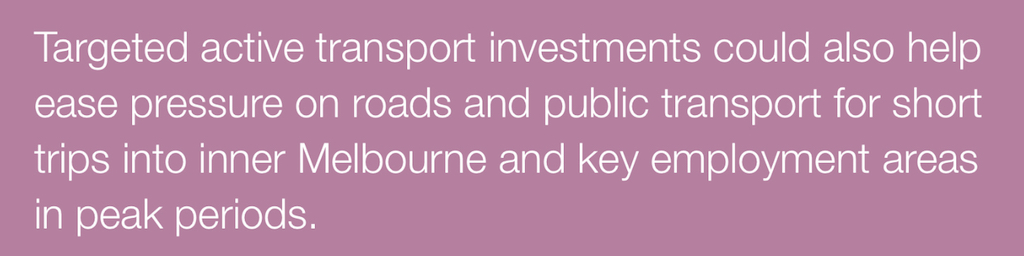
People won’t change modes unless they can see that the alternative is safe and convenient. This requires some reallocation of street space to wider footpaths, protected bicycle lanes and protected public transport stops. In turn, this requires targeted investment, as recommended by Infrastructure Victoria. Note that on-street car parking can still be retained for shopping streets by relocating the parking to the first 5-10 bays on each side street.
Support from the RACV
Victoria’s motoring organisation, the RACV, supports wider footpaths and separated bicycle lanes for Sydney Road in Brunswick, because they realise that congestion will be reduced. The same logic applies to reducing congestion on any shopping street in Yarra.
There are many competing demands for inner city road space, and safety issues as cars, trucks, buses, bicycles, motorcycles, trams and pedestrians all try to fit within narrow corridors. Using roads to park empty cars is not an efficient use of space. That space can be used for bicycle facilities, tram platform stops, loading zones, traffic lanes and wider footpaths – what’s right depends on each road, the people that need safe and efficient passage along the road, and the community they’re passing through. The State Government, Councils and businesses need to work together to identify places where off-street parking can be better utilised, and new off-street parking provided, to enable on-street space to be used differently. RACV supports a trial to remove on-street parking on Sydney Road in early 2018, which can then be considered for the rest of Sydney Road and other streets within inner-Melbourne, including roads in the City of Yarra.
Manager, Roads and Traffic, Public Policy Department, RACV
Conclusion
Yarra’s streets can be better for drivers if some space is reallocated to walking, cycling and public transport, supported by car sharing.
How you can help
You can help by appearing on the Streets Alive Yarra website as a champion for your local street, neighbourhood, or school.